

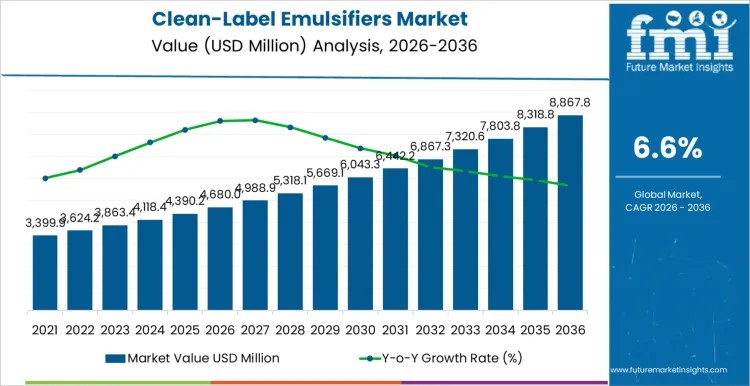
Clean-Label Emulsifiers Market Projected to Nearly Double by 2036, Reaching USD 8,867.8 million with 6.6% CAGR
Clean-Label Emulsifiers Market
Demand driven by ingredient transparency and reformulation in bakery, dairy alternatives, and convenience foods, according to new market forecast.
NEWARK, DE, UNITED STATES, January 19, 2026 /EINPresswire.com/ -- The clean-label emulsifiers market is anticipated to grow from an estimated USD 4,680.0 million in 2026 to USD 8,867.8 million by 2036, exhibiting a steady compound annual growth rate (CAGR) of 6.6% over the next decade. This growth is primarily fueled by food manufacturers’ ongoing reformulation efforts to meet increasing consumer demand for transparent, recognizable ingredients rather than a rise in processed food volumes.
Clean-label emulsifiers, essential for stabilizing oil-water mixtures in various food products, are particularly significant in bakery, dairy alternatives, sauces, and convenience foods. These emulsifiers contribute directly to product texture, shelf life, and visual appeal, making their selection critical amid evolving formulation standards.
Request For Sample Report | Customize Report |purchase Full Report - https://www.futuremarketinsights.com/reports/sample/rep-gb-31465
Market Context and Dynamics
The rising preference for clean-label ingredients has shifted the industry away from synthetic emulsifiers toward plant-based or minimally processed alternatives. Emulsifiers such as lecithins—sourced from soy, sunflower, and rapeseed—and clean-label mono- and diglycerides dominate the market, collectively representing over 60% of demand due to their multifunctionality, regulatory acceptance, and consumer familiarity.
Food producers emphasize emulsifiers that withstand industrial processing conditions including heat, shear, and freeze-thaw cycles while enabling simplified ingredient declarations. This is especially relevant in applications requiring texture integrity and product stability, such as bakery doughs, UHT-treated dairy alternatives, and oil-in-water emulsions in sauces and dressings.
Key Market Segments
By Emulsifier Type:
• Lecithin (36%) leads due to broad application and regulatory favorability.
• Mono- and Diglycerides (24%) serve areas demanding retention of functionality with clean-label positioning.
• Starch-derived emulsifiers (18%) contribute to moisture control and texture.
• Protein-based emulsifiers (14%) provide foaming and emulsification in protein-rich formulations.
• Others account for 8%.
By Application:
• Bakery and Confectionery (31%) drive demand for crumb structure and dough handling properties.
• Dairy and Dairy Alternatives (24%) require protein-compatible emulsifiers for fat stabilization.
• Processed and Convenience Foods (20%) prioritize emulsifiers that maintain reheating and storage stability.
• Beverages (15%) emphasize consistent dispersion and mouthfeel.
• Plant-Based Foods (10%) reflect growing challenges in protein-oil stabilization.
By End User:
• Food and Beverage Manufacturers (75%) lead consumption through large-scale reformulations.
• Ingredient Blenders and Compounders (15%) supply custom emulsifier blends.
• Clean-Label and Natural Food Brands (10%) focus on minimal and recognizable ingredient lists.
Geographic Insights
Growth rates vary globally with emerging markets showing the fastest expansion due to increasing consumer and regulatory demands:
• India: 7.8% CAGR driven by rising packaged food reformulations and retailer standards.
• China: 7.5% CAGR fueled by industrial-scale UHT processing and enzymatic emulsifier adoption.
• Brazil: 7.1% CAGR supported by ambient storage requirements and nutrition labeling-driven reformulation.
• USA: 5.9% CAGR linked to portfolio-wide clean-label transitions and retailer transparency demands.
• UK: 5.7% CAGR influenced by retail-led clean-label standards and reformulation in bakery and ready meals.
Industry Drivers and Challenges
The key factor behind market growth is the industry-wide reformulation to meet consumer preference for simpler, more transparent labels without compromising product performance. Emulsifiers must deliver stability under industrial processing conditions while maintaining sensory qualities such as creaminess and texture.
However, natural emulsifiers face functional limitations compared to synthetic counterparts, especially under high-fat or extreme processing stresses. This necessitates blending multiple emulsifier types to balance performance with label simplicity, increasing formulation complexity and cost. Regulatory interpretations of "natural" or "clean-label" ingredients further influence global formulation strategies, affecting scalability and product rollout.
Competitive Landscape
Major global players dominate the clean-label emulsifiers market by leveraging extensive lecithin and plant-based emulsifier portfolios:
• Cargill leads with broad global sourcing and diverse lecithin offerings.
• ADM emphasizes non-GMO and allergen-conscious emulsifier solutions.
• Ingredion integrates starch-based systems enhancing texture and stability.
• DuPont (IFF) combines emulsification expertise with functional ingredient platforms.
• Lipoid specializes in high-purity lecithins for premium applications.
These companies differentiate through label acceptance, supply reliability, and collaborative formulation support, enabling clients to meet complex clean-label requirements efficiently.
Outlook
The clean-label emulsifiers market is set for continued robust expansion driven by reformulation activity anchored in transparency, regulatory compliance, and consumer demand for familiar ingredients. Although volume growth in processed foods remains moderate, reformulation efforts will intensify, focusing on product categories where emulsification critically impacts quality and shelf life.
As global definitions and regulations evolve, the industry will increasingly rely on multifunctional plant-based, enzymatic, and fermentation-derived emulsifiers to meet performance and label clarity needs, ensuring sustainable growth through 2036.
Browse Related Insights
PVPP Beer Stabilizer Market: https://www.futuremarketinsights.com/reports/pvpp-beer-stabilizer-market
Demand for Tamarind Gum Derivatives in USA: https://www.futuremarketinsights.com/reports/united-states-tamarind-gum-derivatives-market
Beef Grower Market: https://www.futuremarketinsights.com/reports/beef-grower-market
Fermentation Enhancers Market: https://www.futuremarketinsights.com/reports/fermentation-enhancers-market
About Future Market Insights (FMI)
Future Market Insights, Inc. (FMI) is an ESOMAR-certified, ISO 9001:2015 market research and consulting organization, trusted by Fortune 500 clients and global enterprises. With operations in the U.S., UK, India, and Dubai, FMI provides data-backed insights and strategic intelligence across 30+ industries and 1200 markets worldwide.
Sudip Saha
Future Market Insights Inc.
+1 347-918-3531
email us here
Legal Disclaimer:
EIN Presswire provides this news content "as is" without warranty of any kind. We do not accept any responsibility or liability for the accuracy, content, images, videos, licenses, completeness, legality, or reliability of the information contained in this article. If you have any complaints or copyright issues related to this article, kindly contact the author above.
