

Food Stabilizers Market Set for Steady Growth as Demand for Processed Foods and Clean-Label Solutions Rises
food stabilizers market
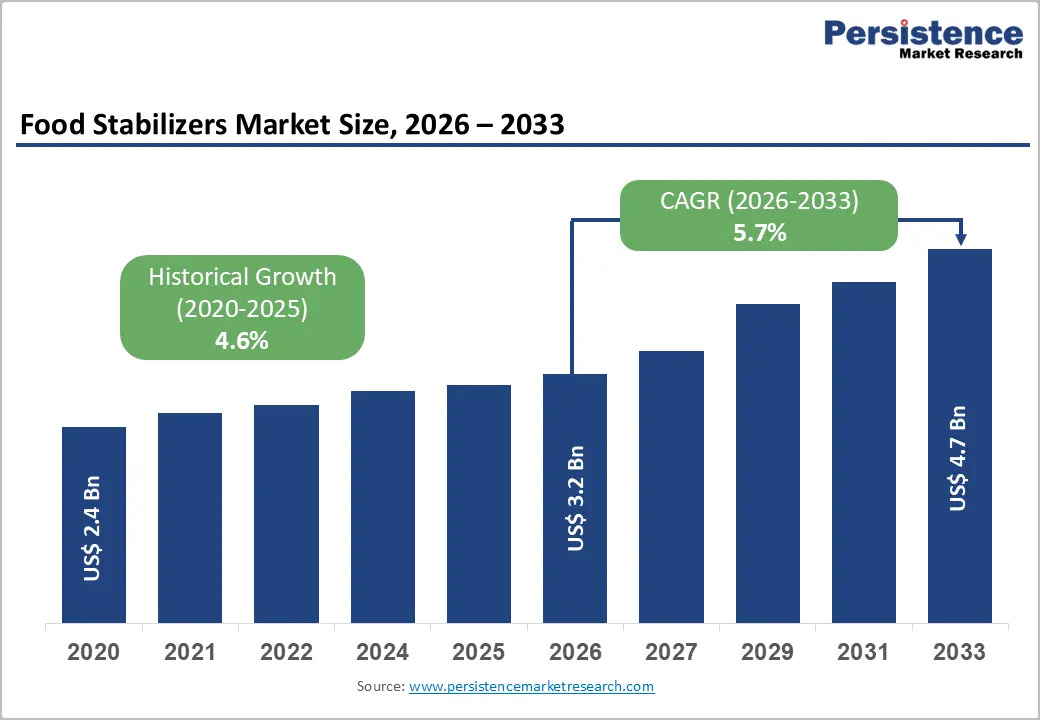
Global Food Stabilizers Market to grow from US$3.2B in 2026 to US$4.7B by 2033, expanding at a 5.7% CAGR driven by processed food demand.
LONDON, UNITED KINGDOM, June 30, 2026 /EINPresswire.com/ -- The global food stabilizers market is projected to witness steady expansion over the coming years as food manufacturers continue investing in advanced ingredient technologies that improve product texture, shelf life, and overall quality. The market is expected to reach a value of US$ 3.2 billion in 2026 and is forecast to grow to US$ 4.7 billion by 2033, registering a compound annual growth rate (CAGR) of 5.7% between 2026 and 2033. The industry previously recorded a CAGR of 4.6% during the 2020–2025 period, highlighting accelerating demand across global food processing sectors.
Download Your Free Sample & Explore Key Insights: https://www.persistencemarketresearch.com/samples/32966
Rising Consumption of Processed Foods Fuels Market Expansion
Changing consumer lifestyles, increasing urbanization, and growing preference for convenient meal options continue to drive demand for food stabilizers worldwide. Processed foods, frozen meals, ready-to-eat products, sauces, dairy desserts, beverages, and bakery products require stabilizers to maintain consistent texture, moisture retention, and visual appeal throughout production, transportation, and storage.
As food products travel through extended supply chains and face varying storage temperatures, stabilizers help prevent separation, texture degradation, and moisture loss. Food manufacturers increasingly rely on these ingredients to ensure product consistency while extending shelf life without frequent formulation changes.
The rapid growth of packaged food consumption across both developed and emerging economies is expected to remain one of the strongest drivers supporting long-term market growth.
Regulatory Challenges Continue to Impact Innovation
Despite positive market prospects, manufacturers continue facing regulatory complexities across different regions. Food safety authorities impose varying approval standards, usage limits, and labeling requirements for stabilizing ingredients, making it difficult for companies operating across multiple international markets.
Growing consumer awareness regarding ingredient transparency also encourages brands to adopt clean-label formulations featuring recognizable ingredients. Reformulating products to meet both regulatory standards and consumer preferences often increases research costs and extends product development timelines. Smaller manufacturers may face greater challenges in complying with evolving regulations while maintaining competitive pricing.
Multifunctional Stabilizer Blends Create New Opportunities
Innovation remains a key competitive strategy within the food stabilizers industry. Manufacturers are increasingly developing multifunctional stabilizer blends capable of delivering thickening, emulsification, moisture retention, and texture enhancement through a single ingredient system.
These advanced blends simplify formulations, reduce ingredient lists, improve processing efficiency, and support clean-label product development. Customized stabilizer systems designed for plant-based dairy alternatives, beverages, bakery products, and sauces are becoming increasingly popular as food companies seek improved functionality under varying processing conditions.
The growing popularity of vegan foods, functional beverages, and plant-based products is expected to create additional opportunities for stabilizer manufacturers focusing on specialized formulation solutions.
Get Custom Insights Designed for Your Businecss: https://www.persistencemarketresearch.com/request-customization/32966
Hydrocolloids Continue Leading Product Segment
Hydrocolloids remain the dominant product category within the food stabilizers market, accounting for approximately 46% of total market share in 2025. Widely used ingredients including xanthan gum, guar gum, carrageenan, and pectin provide thickening, gelling, suspension, and stabilization functions across multiple food applications.
Their ability to deliver consistent performance at relatively low inclusion levels makes hydrocolloids both cost-effective and highly versatile. Food developers continue selecting hydrocolloids because they improve mouthfeel, control viscosity, suspend particles, and maintain product quality without affecting flavor profiles.
Their compatibility with clean-label trends further strengthens their market position as demand for natural and minimally processed ingredients continues rising.
Microbial Sources Gain Momentum
Microbial food stabilizers are projected to record one of the fastest growth rates during the forecast period, expanding at a CAGR of 8.2%. Produced through controlled fermentation processes, these stabilizers provide consistent viscosity, purity, and reliable functionality across beverages, sauces, dairy alternatives, and processed foods.
Fermentation-based production reduces dependence on agricultural variability while supporting stable industrial-scale manufacturing. Ingredients such as xanthan gum and gellan gum continue gaining popularity because they offer excellent stability across different pH levels, heat treatments, and processing conditions while meeting vegan and clean-label requirements.
Asia Pacific Maintains Market Leadership
Asia Pacific continues to dominate the global food stabilizers market, accounting for approximately 39% of total market share. Strong food processing industries, expanding retail networks, and rising consumption of packaged foods support regional market growth.
India has witnessed increasing stabilizer demand across dairy products, bakery items, sauces, and processed foods as manufacturers scale production and improve product shelf stability. China's growing ready-to-eat meal and beverage industries further strengthen regional demand, while Japan focuses on premium food formulations requiring precise texture control. South Korea also continues integrating stabilizers into convenience foods and functional beverages.
Middle East and Africa Emerges as Fastest-Growing Region
The Middle East and Africa region is expected to record the highest regional growth, expanding at a CAGR of 8.3% through 2033. Expanding food manufacturing industries, rapid urbanization, growing foodservice sectors, and increasing demand for shelf-stable products continue driving market expansion.
Manufacturers across Gulf countries increasingly utilize stabilizers in dairy products, beverages, sauces, and desserts designed to withstand high-temperature conditions. Growing packaged food industries in Egypt and several African economies are also encouraging wider adoption of advanced stabilization technologies to improve product quality while minimizing spoilage.
Checkout Now & Download Complete Market Report: https://www.persistencemarketresearch.com/checkout/32966
Market Segmentation
By Product Type
Hydrocolloids
Starch & Derivatives
Emulsifiers
Others
By Source
Plant-based
Animal-derived
Seaweed-derived
Microbial
By End-user
Bakery & Confectionery
Dairy & Frozen Desserts
Beverages
Meat & Poultry Products
Sauces, Dressings & Condiments
Others
By Region
North America
Europe
East Asia
South Asia and Oceania
Latin America
Middle East and Africa
Read Related Reports:
Chondroitin Sulfate Market: The global chondroitin sulfate market is projected to reach US$990.1 million by 2033, driven by joint health, supplements, and cosmetic applications.
Beauty Drinks Market: The global beauty drinks market is expected to reach US$3.5 billion in 2026 and grow to US$8.0 billion by 2033, expanding at a 12.5% CAGR over 2026–2033.
Persistence Market Research
Persistence Market Research Pvt Ltd
+1 646-878-6329
email us here
Visit us on social media:
LinkedIn
Instagram
Facebook
YouTube
X
Legal Disclaimer:
EIN Presswire provides this news content "as is" without warranty of any kind. We do not accept any responsibility or liability for the accuracy, content, images, videos, licenses, completeness, legality, or reliability of the information contained in this article. If you have any complaints or copyright issues related to this article, kindly contact the author above.
